When smaller operators evaluate casino technology, they often focus on:
-
Game catalog size
-
Integration speed
-
Promotional tools
-
Frontend features
Enterprise operators evaluate something different.
They ask:
-
How reliable is the platform?
-
What happens when things break?
-
How quickly are incidents resolved?
-
What guarantees exist for uptime?
At scale, reliability becomes the real product.
This is why modern enterprise casino API platforms are designed around a full reliability stack — not just features.
Let’s explore what enterprise operators expect and why reliability infrastructure defines long-term partnerships.
The Cost of Downtime
In large casino operations, downtime is not just inconvenient.
It is extremely expensive.
Even short outages can cause:
-
Thousands of interrupted sessions
-
Lost bets and gameplay events
-
Player trust erosion
-
Affiliate dissatisfaction
-
Compliance concerns
For enterprise operators running global platforms, even minutes of instability can have significant impact.
This is why reliability is treated as a core operational requirement.
The Enterprise Reliability Stack
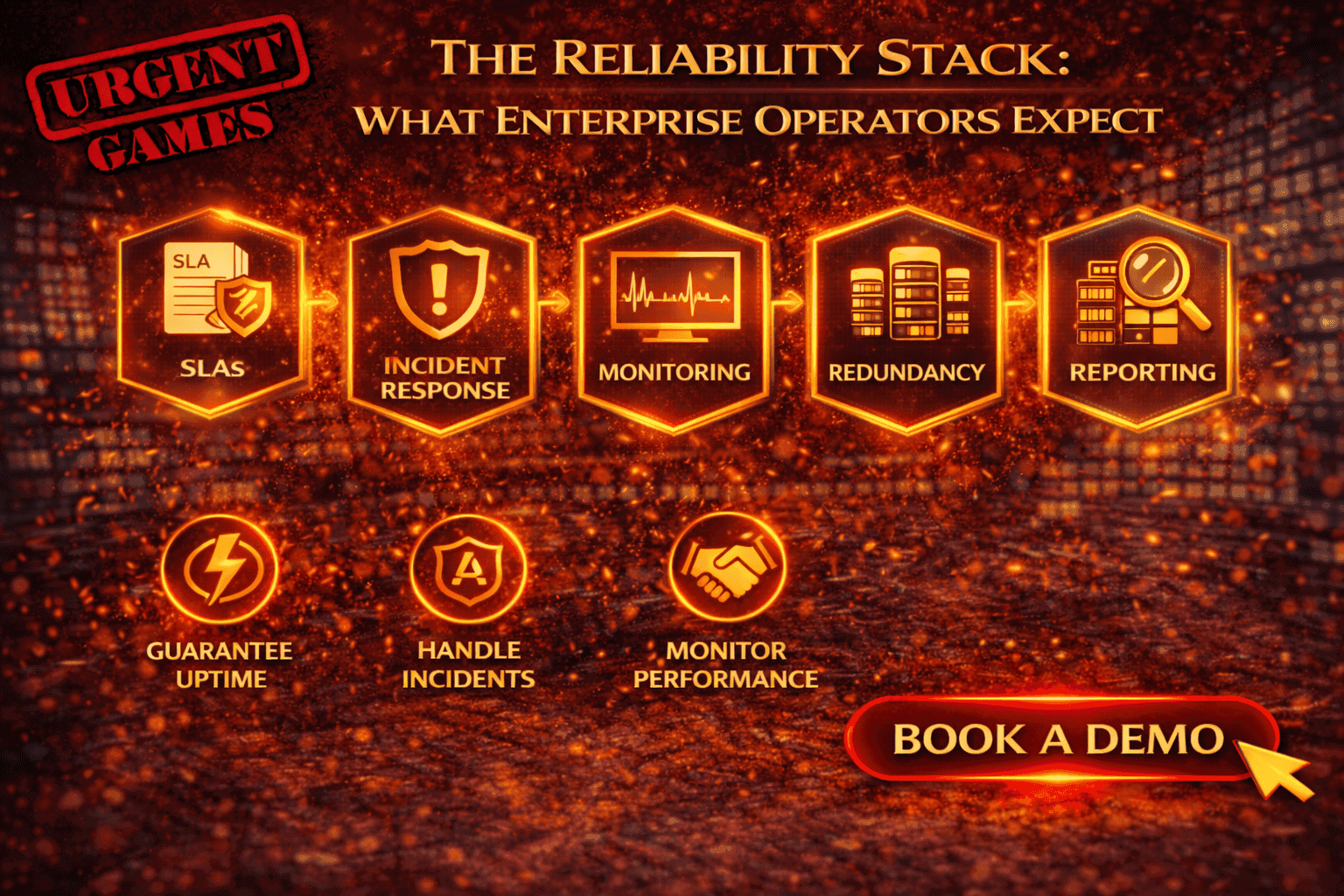
Enterprise-grade casino platforms rely on several layers of reliability infrastructure working together.
These layers include:
-
Service level agreements (SLAs)
-
incident response systems
-
infrastructure monitoring
-
operational reporting
-
redundancy architecture
Together, these components create the reliability stack.
Layer 1: Service Level Agreements (SLAs)
Enterprise operators expect clear contractual reliability guarantees.
Typical SLA commitments include:
-
99.9%+ uptime guarantees
-
maximum incident response time
-
defined resolution targets
-
performance benchmarks
An SLA is not just a legal formality.
It establishes expectations for:
-
system availability
-
operational accountability
-
service quality
Strong enterprise casino API providers publish clear SLAs because reliability is measurable.
Layer 2: Incident Detection and Response
Even the most stable platforms experience incidents.
What matters is how quickly they are detected and resolved.
Enterprise operators expect structured incident management systems.
These typically include:
-
real-time alerting
-
automated anomaly detection
-
incident escalation procedures
-
dedicated response teams
Effective incident handling follows a predictable process:
-
Detection
-
Investigation
-
Containment
-
Resolution
-
Post-incident review
A mature enterprise casino API environment treats incidents as operational events — not emergencies.
Layer 3: Infrastructure Monitoring
Monitoring systems act as the early warning system of reliability.
Enterprise platforms track hundreds of operational signals including:
-
API response times
-
error rates
-
server utilization
-
wallet transaction success rates
-
provider connectivity status
Advanced monitoring dashboards provide:
-
real-time performance visibility
-
automated alerts
-
predictive anomaly detection
This allows operators to identify problems before players notice them.
Layer 4: Redundancy and Failover Architecture
Enterprise systems must be resilient to infrastructure failures.
Reliability stacks often include:
-
multi-region server deployment
-
automatic failover systems
-
load balancing
-
database replication
If one component fails, traffic automatically reroutes to healthy infrastructure.
This redundancy ensures that even during infrastructure disruption, the platform continues operating.
For enterprise operators, resilience is not optional — it is expected.
Layer 5: Event Logging and Traceability
When issues occur, operators must understand exactly what happened.
Enterprise platforms maintain detailed logs for:
-
API calls
-
wallet transactions
-
game session events
-
provider responses
-
system errors
Traceability allows teams to reconstruct the sequence of events leading to an issue.
This dramatically accelerates debugging and resolution.
Without proper logging, troubleshooting becomes guesswork.
Layer 6: Operational Reporting
Enterprise operators need visibility into platform performance.
Modern enterprise casino API providers offer operational reporting dashboards that track:
-
uptime metrics
-
API latency trends
-
provider performance
-
incident frequency
-
service degradation alerts
This transparency builds confidence between operators and platform providers.
Reliable systems should also be observable systems.
The Role of Monitoring in Player Experience
Reliability monitoring is not just about infrastructure.
It directly affects player experience.
For example, monitoring systems can detect:
-
slow game loading times
-
delayed wallet responses
-
provider callback failures
-
transaction processing delays
By detecting these issues early, operators prevent negative player experiences before they escalate.
This is why monitoring is a core component of the reliability stack.
Incident Transparency Matters
Enterprise operators also expect transparency during incidents.
When disruptions occur, they expect:
-
clear communication
-
status updates
-
estimated resolution timelines
-
post-incident analysis
Professional incident management includes post-mortem reports that explain:
-
what caused the issue
-
what was done to resolve it
-
how future incidents will be prevented
Transparency builds long-term trust between operators and technology partners.
Reliability Enables Growth
Reliability is not just a defensive strategy.
It enables growth.
Stable platforms allow operators to:
-
onboard new markets confidently
-
run high-traffic campaigns
-
scale player volume
-
integrate additional providers
Without strong reliability infrastructure, scaling becomes risky.
Enterprise operators choose partners who can grow with them.
The Shift Toward Enterprise-Grade Platforms
As the iGaming industry matures, expectations are rising.
Enterprise operators no longer accept:
-
unstable APIs
-
unpredictable outages
-
slow incident response
Instead, they demand:
-
robust infrastructure
-
transparent operations
-
measurable service guarantees
This shift is pushing casino platforms toward enterprise reliability standards.
What Defines a True Enterprise Casino API
An enterprise-grade casino API typically offers:
-
high availability architecture
-
comprehensive monitoring systems
-
automated incident detection
-
structured incident management
-
detailed operational reporting
These capabilities transform a platform from a simple integration layer into a dependable technology backbone.
Final Thought
Game catalogs attract attention.
But reliability earns long-term partnerships.
Enterprise operators don’t just evaluate what a platform can do.
They evaluate how consistently it performs.
The strongest platforms combine rich content with a powerful reliability stack.
And that is what enterprise operators expect.
🚀 Book a Demo
If you’re looking for an enterprise casino API built with reliability, monitoring, and operational transparency at its core, the right infrastructure makes all the difference.
Build a platform your operators — and their players — can depend on.