Introduction
Wallet synchronization is one of the most critical challenges facing modern gaming platforms. Nothing damages player trust faster than an incorrect balance.
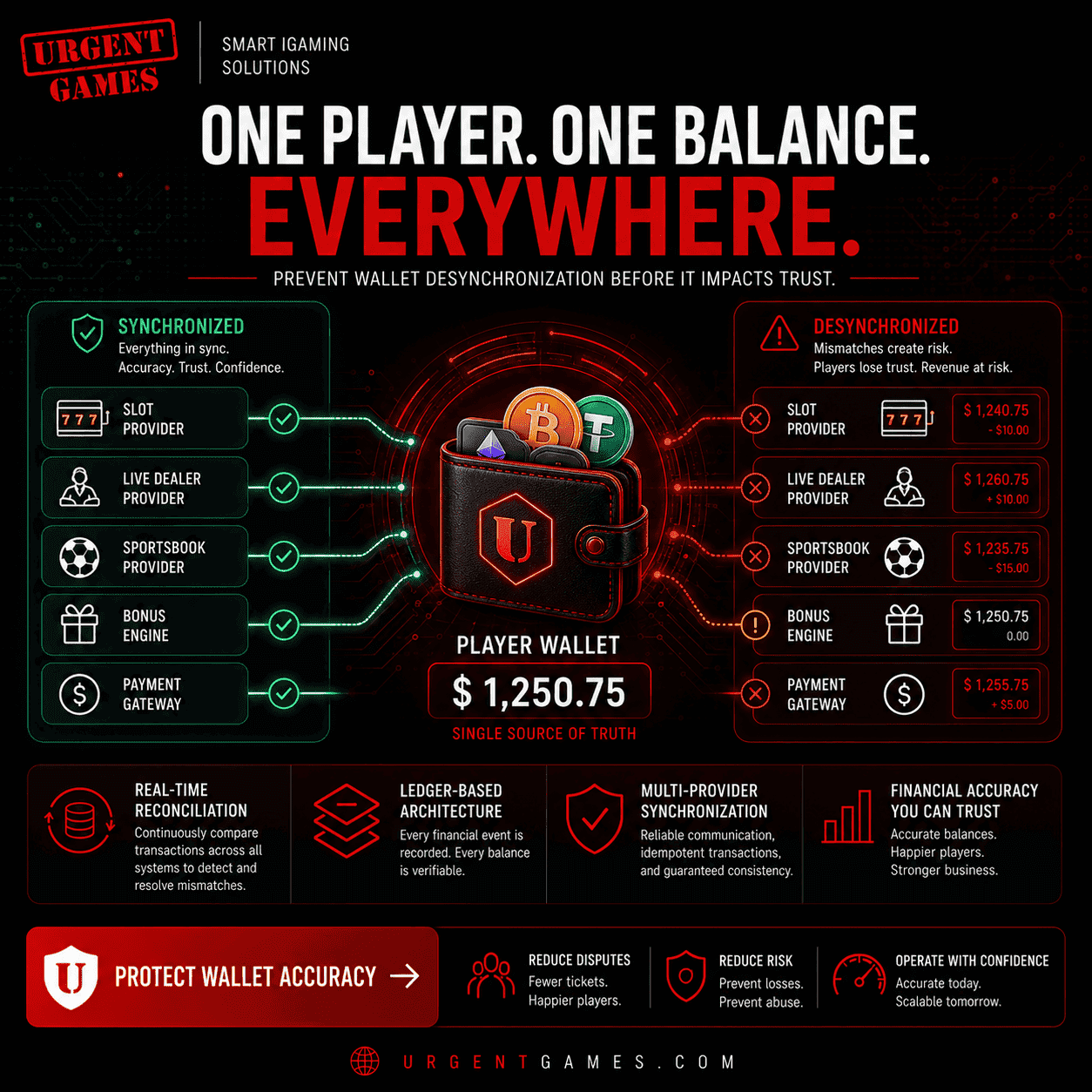
A player may enter a game with $500, win a bonus round, return to the lobby, and discover that their balance no longer reflects their winnings. From the player's perspective, the platform appears broken. However, from the operator's perspective, the real issue is wallet desynchronization.
As operators integrate more casino providers, sportsbooks, payment gateways, bonus systems, and third-party content, maintaining accurate wallet synchronization becomes increasingly complex.
The challenge is no longer simply tracking balances. Instead, it is ensuring that every connected system agrees on the player's balance at all times.
What Is Wallet Synchronization and Desynchronization?
Wallet desynchronization occurs when two or more systems disagree about a player's balance.
Example:
- Provider Balance: $750
- Operator Wallet: $650
- Player View: $700
Result:
Nobody knows which balance is correct.
This creates:
- Support tickets
- Financial risk
- Trust issues
- Reconciliation challenges
Therefore, strong wallet synchronization mechanisms are essential for maintaining consistency across gaming ecosystems.
Why Wallet Synchronization Matters for Gaming Platforms
The wallet sits at the center of:
- Deposits
- Withdrawals
- Gameplay
- Bonuses
- Promotions
- Sports betting
When synchronization fails, every connected service becomes less reliable.
Ultimately, balance accuracy is trust infrastructure.
For additional insights, see our Unified Wallet Architecture Guide.
Network Failures and Wallet Synchronization Issues
One of the most common causes of desynchronization is communication failure.
For example:
- A player places a bet.
- The provider processes the wager.
- The response never reaches the operator.
As a result:
- The provider updates the balance.
- The operator does not.
Synchronization breaks immediately.
Modern platforms must design for network failures rather than assuming perfect communication.
How API Timeouts Impact Wallet Synchronization
Many gaming integrations rely on:
- HTTP requests
- API callbacks
- Provider webhooks
However, timeouts create uncertainty.
Questions arise such as:
- Did the transaction succeed?
- Did it fail?
- Should the transaction be retried?
Without safeguards, connected systems may reach different conclusions, causing balance inconsistencies.
Why Idempotency Is Critical for Wallet Synchronization
Another common source of wallet errors is duplicate transaction processing.
Consider the following scenario:
- A provider sends a transaction.
- A network issue occurs.
- The provider retries the request.
- The transaction processes twice.
To prevent this, modern systems use idempotency keys.
Each financial event receives a unique transaction identifier.
If the same event appears again, the system ignores duplicates.
This protects wallet synchronization and prevents balance drift.
For API reliability best practices, visit Stripe API Idempotency Guide.
Concurrency Control and Balance Consistency
Large gaming platforms process thousands of financial events every second.
Examples include:
- Bonus credits
- Bet placements
- Withdrawal requests
These actions may occur within milliseconds of each other.
Without concurrency management, race conditions emerge.
Modern platforms address this through:
- Atomic transactions
- Transaction locking
- Event sequencing
As a result, balance consistency remains intact.
Wallet Synchronization Challenges Across Multiple Providers
Most operators connect to:
- Casino providers
- Sportsbook platforms
- Bonus engines
- Payment systems
Each provider introduces:
- Different APIs
- Different settlement logic
- Different timing behaviors
Consequently, complexity increases rapidly.
This is why many operators invest in centralized wallet orchestration layers.
Learn more in our Multi-Provider Gaming Integration Guide.
Why Ledger-Based Wallet Synchronization Works Better
Modern gaming platforms increasingly use ledger-first architecture.
Instead of updating balances directly, every financial action becomes a ledger event.
Examples include:
- Deposit Created
- Bet Placed
- Win Settled
- Withdrawal Approved
A ledger creates a single source of truth.
Balances become the result of transaction history rather than arbitrary balance updates.
This significantly improves wallet synchronization accuracy.
Event-Driven Wallet Synchronization Architecture
Many operators are moving toward event-driven systems.
Benefits include:
- Better scalability
- Improved auditability
- Easier recovery
- Stronger consistency
Every balance change becomes traceable and verifiable.
For event architecture guidance, review Apache Kafka Documentation.
Real-Time Reconciliation for Wallet Synchronization
Synchronization should never rely on assumptions.
Instead, modern platforms continuously compare:
- Operator records
- Provider records
- Ledger records
The objective is simple:
Identify balance drift immediately.
Real-time reconciliation reduces operational risk and improves financial accuracy.
Automated Reconciliation Improves Financial Accuracy
Modern reconciliation systems automatically detect:
- Missing transactions
- Duplicate transactions
- Settlement mismatches
- Provider discrepancies
As a result, teams can resolve issues before players notice them.
This dramatically reduces support costs and balance disputes.
Observability and Wallet Synchronization Monitoring
Strong wallet systems require complete financial observability.
Teams should monitor:
Financial Metrics
- Reconciliation success rates
- Settlement accuracy
- Duplicate transaction rates
Technical Metrics
- Callback failures
- API latency
- Queue delays
Operational Metrics
- Support tickets
- Balance disputes
- Provider mismatch incidents
Monitoring provides early warning signs before small issues become major incidents.
For observability best practices, see OpenTelemetry Documentation.
Shared Wallet Synchronization Across Gaming Products
Unified wallets improve player experience.
However, they also increase synchronization demands.
Players may move between:
- Sportsbooks
- Slots
- Live dealer games
- Crash games
Using a single balance.
Consequently, every integration must remain synchronized in real time.
Multi-Currency Wallet Synchronization Considerations
Modern wallets increasingly support:
- USD
- EUR
- BRL
- Stablecoins
- Crypto assets
Additional complexity includes:
- Exchange rates
- Conversion timing
- Settlement consistency
Therefore, synchronization controls become even more important in multi-currency environments.
Common Wallet Synchronization Mistakes
Updating Balances Directly
Use event-driven ledgers whenever possible.
Ignoring Idempotency Controls
Duplicate processing becomes inevitable.
Delaying Reconciliation
Small discrepancies can become major incidents.
Weak Monitoring
Hidden problems often grow unnoticed.
Avoiding these mistakes significantly improves platform reliability.
The Future of Wallet Synchronization
The next generation of wallet infrastructure increasingly includes:
- Event-driven ledgers
- Real-time reconciliation
- AI-powered anomaly detection
- Automated dispute resolution
- Multi-provider synchronization layers
Why?
Because wallet accuracy is becoming a competitive advantage.
Platforms that maintain consistent balances build stronger player trust and operational resilience.
Final Thoughts
Players rarely notice when balances are correct.
However, they immediately notice when balances are wrong.
Modern wallet synchronization requires:
- Strong architecture
- Real-time monitoring
- Ledger-first design
- Idempotent transaction processing
- Continuous reconciliation
The most successful operators understand that wallet accuracy is not simply a technical objective.
It is a trust objective.
Because in modern iGaming, every balance is a promise.
Wallet synchronization ensures that promise is kept.