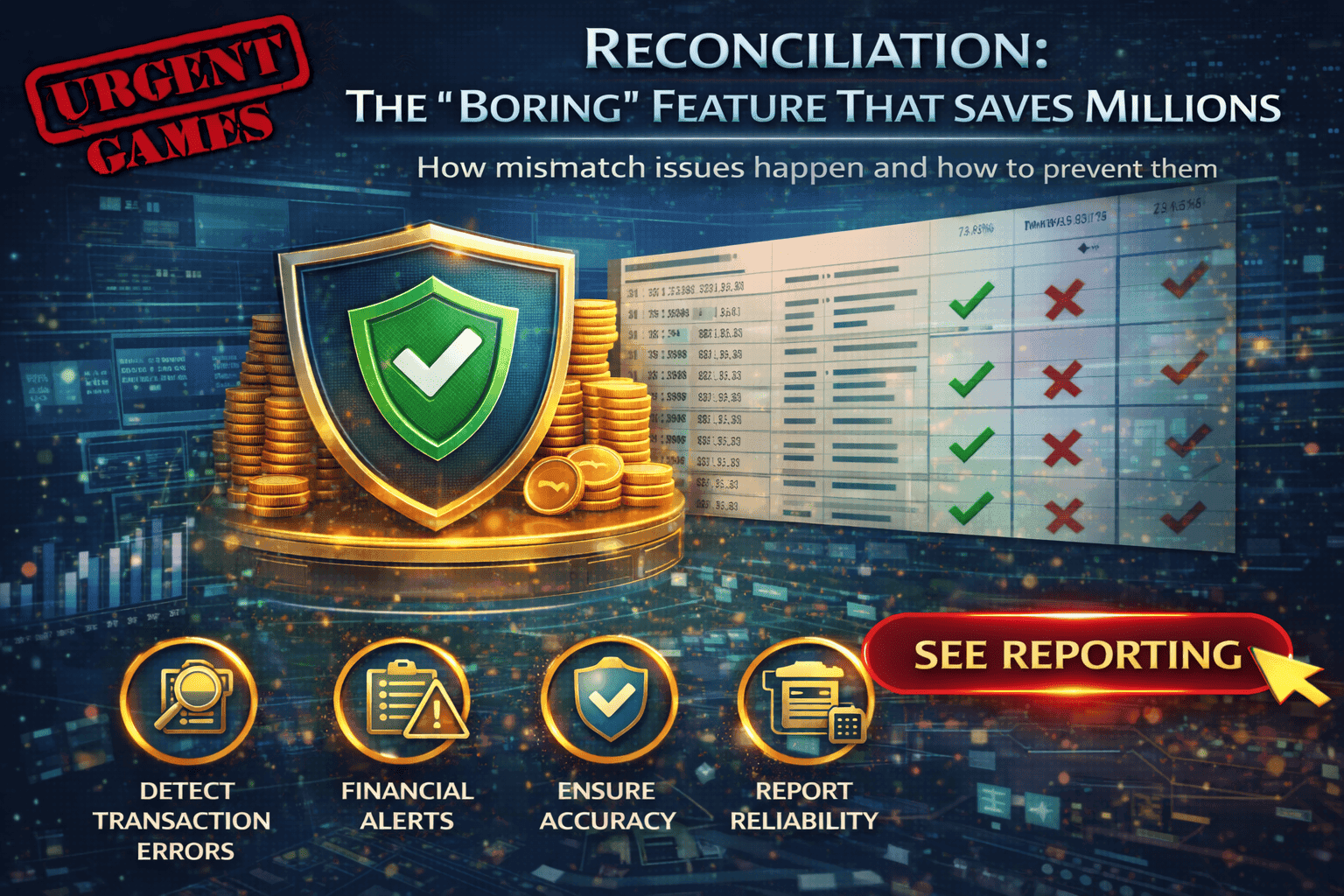
When operators evaluate gaming platforms, they usually focus on exciting capabilities like new game integrations, real-time analytics, promotional tools, and player engagement features.
However, one of the most important systems rarely enters the conversation: casino reconciliation.
It sounds operational.
It sounds technical.
And at first glance, it may even sound boring.
Yet behind the scenes, casino reconciliation is one of the most critical systems inside a casino platform.
When reconciliation fails, the consequences can be extremely expensive.
Across large-scale casino operations, reconciliation failures often lead to:
-
financial discrepancies
-
incorrect wallet balances
-
payout disputes
-
accounting inconsistencies
-
regulatory compliance risks
For this reason, a strong casino reconciliation system quietly protects operators every single day.
What Casino Reconciliation Actually Means
In simple terms, casino reconciliation ensures that financial records match across all systems involved in gaming transactions.
A modern casino platform typically processes data from several independent systems simultaneously, including:
-
game providers
-
wallet services
-
bonus engines
-
payment gateways
-
reporting systems
Each of these systems records transactions independently.
Therefore, reconciliation verifies that every number across these systems aligns perfectly.
If even a small mismatch appears, something has gone wrong somewhere in the transaction chain.
Over time, even tiny discrepancies can grow into major operational problems.
Why Casino Reconciliation Mismatches Happen
Casino platforms process millions of transactions daily. Every spin, bet, win, rollback, and bonus event generates financial data.
Because so many systems interact simultaneously, mismatches can occur for several reasons.
1. Network Latency and Provider Timeouts
Occasionally, provider callbacks arrive late or temporarily fail.
For example:
-
a bet is recorded internally
-
the provider response arrives seconds later
-
reporting systems log events out of order
Without reconciliation checks, this sequence can produce inconsistent financial records.
2. Duplicate Transactions
Sometimes systems retry failed requests automatically.
If safeguards are missing, duplicate transactions can occur.
Common examples include:
-
duplicate bet placements
-
repeated settlement messages
-
duplicated rollback events
These issues distort reporting and may directly affect player wallet balances.
3. Provider Settlement Differences
Not all game providers report transactions in the same way.
Some providers report individual bet outcomes, while others send batched settlement reports.
As a result, discrepancies may appear between:
-
provider financial reports
-
internal wallet records
A well-designed casino reconciliation system bridges these structural differences.
4. Rollbacks and Error Recovery
When game sessions fail mid-round, rollback mechanisms restore player balances.
However, if rollback events are not processed consistently across systems, mismatches occur.
These situations are particularly sensitive because they involve direct player funds.
The Financial Risk of Ignoring Casino Reconciliation
Even small discrepancies can accumulate quickly.
For instance, if just 0.01% of transactions contain mismatches, large platforms may generate thousands of inconsistent entries daily.
Over time this may result in:
-
inaccurate GGR reporting
-
financial leakage
-
increased player disputes
-
incorrect tax calculations
Furthermore, in regulated jurisdictions reconciliation issues can trigger regulatory audits and compliance investigations.
What initially appears to be a minor technical issue can rapidly evolve into a major operational risk.
The Three Layers of Effective Casino Reconciliation
Strong reconciliation systems operate across three verification layers.
Layer 1: Transaction-Level Verification
At the most granular level, reconciliation compares individual transaction records across systems.
For each transaction the platform verifies:
-
bet amount
-
win amount
-
player ID
-
provider ID
-
timestamp
-
transaction ID
If any value differs, the system immediately flags the mismatch.
Layer 2: Aggregate Financial Validation
Next, reconciliation analyzes aggregated financial totals.
Examples include:
-
daily bet totals
-
provider win totals
-
session-level outcomes
-
wallet balance changes
Even if individual mismatches are difficult to detect, aggregated comparisons quickly reveal inconsistencies.
Layer 3: Automated Alerts and Reporting
Detection alone is not enough.
Therefore, advanced casino reconciliation systems trigger automated alerts whenever discrepancies appear.
These alerts help operators investigate issues such as:
-
missing provider callbacks
-
delayed settlement events
-
wallet synchronization failures
Because of automated monitoring, problems can be resolved before they escalate.
Preventing Reconciliation Errors Before They Happen
The best systems do not only detect problems.
Instead, they prevent mismatches from occurring in the first place.
Several architectural practices dramatically reduce reconciliation errors.
Idempotent Transactions
Idempotency ensures that duplicate requests cannot create duplicate transactions.
If the same request is sent multiple times, the system processes it only once.
Unique Transaction Identifiers
Every bet and settlement should include a unique transaction ID shared across all systems.
This allows reconciliation tools to track each event accurately.
Event Logging and Traceability
Detailed logs make it possible to trace the exact sequence of events leading to a mismatch.
Without proper traceability, debugging becomes extremely difficult.
Real-Time Monitoring
Monitoring systems can also detect anomalies such as:
-
unexpected spikes in bet volume
-
abnormal settlement patterns
-
delayed provider responses
Because issues are detected early, reconciliation errors become much easier to manage.
Why Enterprise Operators Prioritize Casino Reconciliation
Large gaming operators treat casino reconciliation as core platform infrastructure.
They understand that:
-
financial accuracy builds trust
-
clean reporting supports compliance
-
reliable accounting protects revenue
Strong reconciliation provides confidence that every bet and every payout is recorded correctly.
This is especially important for operators managing:
-
multiple game providers
-
multi-currency wallets
-
global payment networks
In these complex environments, reconciliation is not optional.
It is essential.
The Competitive Advantage of Strong Reconciliation
Operators with reliable reconciliation infrastructure benefit from:
-
accurate financial reporting
-
fewer player disputes
-
faster issue resolution
-
improved regulatory compliance
-
stronger operational stability
Meanwhile, platforms without robust reconciliation systems often face persistent accounting issues that consume operational resources and damage credibility.
The Quiet Backbone of Casino Platforms
Casino reconciliation rarely appears in marketing headlines.
Players never see it.
Operators rarely celebrate it.
Nevertheless, every reliable casino platform depends on it.
Without reconciliation, even advanced gaming platforms risk hidden financial instability.
With it, operators gain confidence that every transaction is accounted for.
Final Thought
Not every important feature is exciting.
Some of the most valuable systems operate quietly in the background.
Casino reconciliation is one of them.
While it may be invisible to players, it protects millions in gaming revenue every single day.
See Reporting
If you want stronger casino reconciliation systems with accurate transaction tracking, automated mismatch detection, and reliable financial reporting, the right platform architecture makes all the difference.
Turn operational complexity into financial confidence.