Nothing damages player trust faster than balance inconsistencies.
A player deposits money, but the balance does not update.
A withdrawal succeeds, but the wallet still shows available funds.
A provider reports one amount while your ledger reports another.
These issues are not just technical bugs. They are symptoms of a deeper architectural problem: multiple systems trying to define the “real” balance.
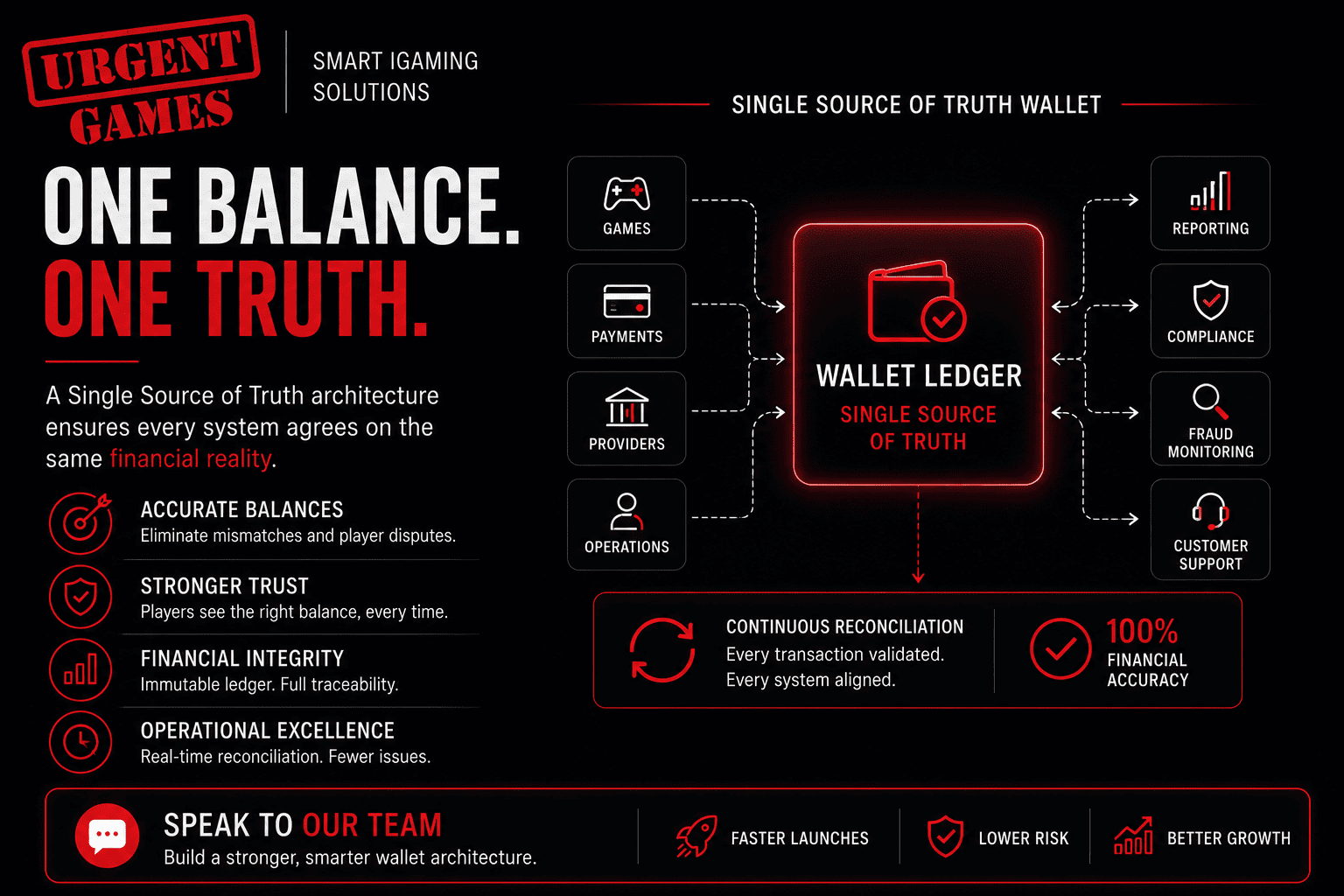
This is why modern iGaming platforms increasingly rely on a Single Source of Truth (SSOT) wallet architecture.
Strong wallet balance management is not just about storing balances. It is about ensuring every system agrees on the same financial reality.
What Is a Single Source of Truth Wallet Architecture?
A Single Source of Truth wallet architecture means one authoritative system defines the correct balance state.
Every other service:
- Reads from it
- Syncs with it
- Validates against it
But no other system independently overrides balance data.
This approach significantly reduces reconciliation failures and balance inconsistencies in modern iGaming platforms.
Why Balance Inconsistencies Happen in iGaming Platforms
Most balance problems originate from:
- Distributed systems
- Delayed synchronization
- Duplicate transaction handling
- Provider mismatches
- Weak reconciliation design
The core issue is simple:
Too many systems modify balance state independently.
The Multi-Balance Problem in Wallet Systems
Many operators unintentionally create multiple balance states, including:
- Wallet balance
- Provider balance
- Session balance
- Cached balance
Over time, these systems diverge.
The result:
- Reconciliation becomes painful
- Financial ambiguity increases
- Player trust breaks down
A Single Source of Truth wallet architecture eliminates this fragmentation.
Why Reconciliation Fails
Reconciliation fails when systems disagree about transaction history.
For example:
A provider reports:
Bet processed successfully
But the wallet system reports:
Transaction failed
Now the financial state becomes unclear.
Without strong wallet architecture, determining the correct balance becomes difficult and expensive.
Why Real-Time Gaming Makes Wallet Balance Management Harder
Modern iGaming platforms process:
- Thousands of transactions per second
- Multiple provider integrations simultaneously
- Real-time balance updates
This creates:
- Race conditions
- Timing conflicts
- Partial failures
Without proper wallet balance management, balance drift becomes inevitable.
Ledger-First Wallet Architecture
Modern platforms increasingly use ledger-first wallet architecture instead of directly updating balances.
In this model, every financial action becomes an immutable ledger event.
Examples include:
- Deposit created
- Bet placed
- Win credited
- Withdrawal processed
Balances are calculated from ledger history rather than manually adjusted.
Why Immutable Ledger Systems Matter
Immutable ledger systems improve:
- Auditability
- Recoverability
- Financial traceability
- Regulatory confidence
Most importantly, they reduce ambiguity during reconciliation.
Strong wallet balance management systems never edit financial history directly.
Instead, corrections happen through:
- Reversals
- Compensation transactions
- Adjustment entries
Mutable financial history destroys audit confidence and creates operational risk.
Real-Time Reconciliation Is Essential
One of the biggest operator mistakes is running reconciliation only periodically.
Modern wallet systems reconcile continuously in real time by comparing:
- Provider records
- Internal ledgers
- Wallet balances
Continuous reconciliation allows teams to identify inconsistencies before they impact players.
Idempotency Prevents Duplicate Transactions
Duplicate transaction processing is a major source of balance inconsistencies.
Common causes include:
- Provider retries
- Network timeouts
- Queue replay events
Modern wallet balance management systems use:
- Unique transaction IDs
- Idempotency validation
- Duplicate prevention checks
This ensures the same transaction cannot process twice.
Event-Driven Wallet Systems Reduce Financial Risk
Modern iGaming platforms increasingly use:
- Event queues
- Async transaction processing
- Append-only ledgers
Event-driven wallet systems improve:
- System resilience
- Recovery capabilities
- Transaction consistency
- Operational scalability
They also help prevent partial state corruption during failures.
Provider Integrations Are a Major Reconciliation Risk
Many reconciliation issues originate from third-party providers.
Common problems include:
- Delayed callbacks
- Mismatched transaction states
- Incomplete settlement events
Best practices include:
- Validating all provider callbacks
- Storing raw provider events
- Enforcing transaction uniqueness
- Maintaining immutable audit logs
Cached Balances Can Create Dangerous Inconsistencies
Caching improves performance, but introduces risk.
A dangerous scenario occurs when:
- The cached balance shown to the player differs from the actual ledger balance
A safer approach is to:
- Cache carefully
- Validate critical transactions directly against the ledger
- Prioritize ledger accuracy over display speed
Concurrency Control in Wallet Balance Management
Multiple simultaneous requests can corrupt balances.
Example:
Two withdrawals process at the same time.
Without concurrency protection, both may succeed incorrectly.
Common Concurrency Protection Methods
1. Row-Level Database Locking
Prevents simultaneous balance modification.
2. Queue Serialization
Processes wallet events sequentially for each player.
3. Optimistic Concurrency Control
Automatically rejects conflicting updates.
Observability Improves Financial Integrity
You cannot fix what you cannot see.
Modern operators monitor:
- Balance mismatches
- Duplicate transaction attempts
- Provider inconsistencies
- Delayed settlement events
- Wallet processing latency
Real-time alerts help teams respond before issues escalate.
Metrics That Matter for Wallet Balance Management
Instead of vanity metrics, operators should track:
- Reconciliation success rate
- Wallet mismatch frequency
- Transaction processing latency
- Duplicate prevention rate
- Provider settlement accuracy
These metrics directly impact financial integrity and player trust.
Common Wallet Architecture Mistakes
Multiple Systems Updating Balances Independently
This creates balance drift and reconciliation failures.
Mutable Financial Records
Editing transaction history destroys traceability.
Weak Provider Validation
Poor validation creates inconsistent financial states.
Periodic-Only Reconciliation
Issues remain hidden for too long.
Why Strong Consistency Matters in Wallet Systems
Some distributed systems tolerate temporary inconsistency.
Wallet systems usually cannot.
Players expect:
- Immediate balance accuracy
- Real-time updates
- Reliable financial transactions
Strong consistency is critical for modern wallet balance management.
The Future of Wallet Balance Management
The next generation of iGaming platforms is moving toward:
- Event-sourced ledgers
- Real-time reconciliation
- Immutable transaction history
- Distributed tracing
- Automated financial integrity checks
As transaction complexity grows, financial integrity becomes a competitive advantage.
Final Thoughts on Single Source of Truth Wallet Architecture
Players may not understand:
- Ledger architecture
- Event sourcing
- Concurrency control
But they immediately understand:
- Missing money
- Incorrect balances
- Delayed wallet updates
Strong wallet balance management systems create:
- Financial trust
- Operational confidence
- Scalable infrastructure
- Better long-term retention
In iGaming, your wallet system is your reputation.
Related Resources
- Explore our casino wallet integration solutions
- Learn more about real-time reconciliation systems
- Read our guide to event-driven iGaming platform architecture
Speak to Our Team
Want to build a modern wallet architecture with real-time reconciliation and stronger financial integrity?